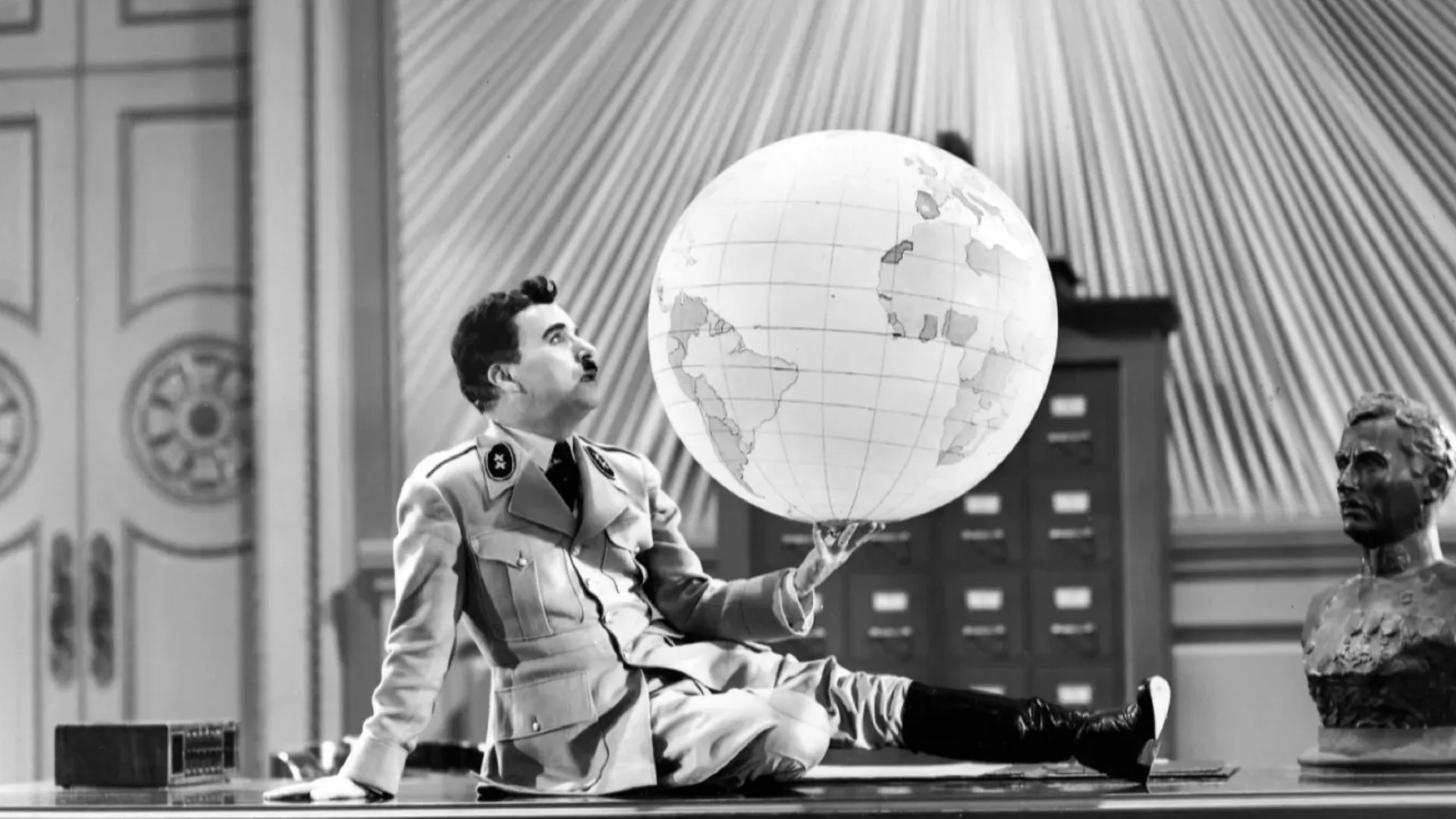
© Roy Export SAS
Comic Rebellion Against Fascist Spectacle
Film
The Great Dictator
Year
1940
Director
Charlie Chaplin
DOP
Karl Struss, Roland Totheroh
Country
USA
Timestamp
00:55:21
11.3.2026
When Charlie Chaplin released The Great Dictator in 1940, he did something few artists dared to attempt, he turned the most terrifying political phenomenon of his time into a target of laughter. His satirical portrayal of Adolf Hitler (reimagined as “Adenoid Hynkel, Dictator of Tomainia”) was not only a cinematic act of courage, but also a direct, deliberate reaction to Leni Riefenstahl’s Triumph of the Will (1935), the defining visual manifesto of Nazi ideology.
Chaplin had seen Riefenstahl’s film and been both horrified and fascinated. He screened Triumph of the Will privately in Hollywood, studying its images closely. The film’s chilling fusion of mass choreography, religious iconography, and visual perfection haunted him. In response, The Great Dictator became an inversion of Riefenstahl’s aesthetic: where she filmed adoring crowds bowing to a mythic leader, Chaplin presented a buffoon commanding obedience through vanity and fear. Where Riefenstahl used cinema to glorify power, Chaplin used it to dismantle it through laughter.
Historical Context
Chaplin began writing The Great Dictator in 1938, when most of the world still clung to the illusion of peace. The Anschluss had occurred, Kristallnacht had taken place, but Britain and the United States remained officially neutral. Until 1939, Hollywood studios avoided direct criticism of Nazism, fearing German market losses or accusations of warmongering. Chaplin, who had built his global fame as the Little Tramp — an everyman known for humanism and pathos — was now one of the few filmmakers willing to take aim at tyranny itself.
In the late 1930s, Triumph of the Will had spread through international film circuits. American newsreels excerpted its images of torchlit rallies and meticulously synchronized marches, often without commentary. Chaplin saw what Riefenstahl’s imagery could do — how its monumental aesthetics rendered fascism seductive. His response was to expose the absurdity beneath the spectacle.
When he began shooting in September 1939, Hitler had just invaded Poland and World War II had officially begun. By the time the film premiered in October 1940, Germany had conquered most of Western Europe, and the United States had yet to enter the war. The Great Dictator thus arrived at a perilous moment — a comedy made while the world was burning.
Narrative Overview
Chaplin’s film tells two parallel stories united by mistaken identity. One concerns Adenoid Hynkel, the dictator of Tomainia — a thinly veiled Hitler parody. The other follows a Jewish barber, a humble man who wakes from a World War I injury-induced coma to find his country consumed by fascism.
The barber, played by Chaplin in a dual role, represents innocence, decency, and the ordinary human spirit. Hynkel, meanwhile, is a grotesque caricature — a shrill demagogue obsessed with glory, racial purity, and personal adoration. The film alternates between the absurd grandeur of Hynkel’s dictatorship and the quiet suffering of the ghetto, creating a moral contrast between delusional power and humble humanity.
In the final act, the barber is mistaken for Hynkel and forced to deliver a public speech. Instead of continuing the masquerade, he abandons the pretense of parody and speaks directly to the audience — a full-throated plea for compassion, peace, and democracy. This concluding monologue, often viewed as Chaplin’s own voice breaking through the film, transforms satire into manifesto.
Chaplin’s Encounter with Triumph of the Will
Chaplin reportedly watched Riefenstahl’s Triumph of the Will multiple times while preparing The Great Dictator. According to several accounts from crew members and historians, he projected the film privately in Hollywood and studied it frame by frame to understand its allure.
What struck him most was not the ideology itself, but the perfection of its presentation — the way Riefenstahl’s camera worshipped symmetry, ritual, and order. The visual language of Triumph of the Will was one of purity and power: infinite rows of soldiers, godlike angles of Hitler gazing at the masses, and the rhythmic pulsing of flags and trumpets. Chaplin grasped instinctively that such beauty could conceal monstrous intentions.
In response, The Great Dictator mimics, parodies, and dismantles Riefenstahl’s visual vocabulary. Where Triumph of the Will sanctifies the Führer, Chaplin deflates him into a clown. The film becomes a comic mirror image of Nazi propaganda — using identical techniques of framing, choreography, and music, but turning them inside out.
Aesthetic Parallels
The Leader’s Entrance
In Triumph of the Will, Hitler arrives in Nuremberg by plane, descending through clouds as if from heaven—a mythic second coming. Crowds weep and salute; the camera gazes upward in awe.
In The Great Dictator, Chaplin stages Hynkel’s arrival for an enormous rally with the same pomp and aerial framing—but he immediately undercuts it. The crowd’s chants blur into nonsense syllables; the banners proclaim empty slogans; and Hynkel’s opening speech devolves into a stream of mock German gibberish—a hysterical, rhythmic nonsense that sounds meaningful but says nothing.
Where Riefenstahl elevated the Führer’s words into sacred revelation, Chaplin strips them of meaning altogether, exposing fascist rhetoric as sound without substance.
Mass Spectacle as Absurd Theater
Riefenstahl’s crowds in Triumph of the Will are disciplined, perfectly aligned, and silent until permitted to roar. Their order suggests divine unity. Chaplin, in contrast, presents the same choreography as comic chaos. Soldiers goose-step out of sync, officials stumble over each other, banners fall.
The architecture of Hynkel’s palace — dominated by massive eagles and marble busts — echoes the monumental settings of Nuremberg, yet its oversized scale turns the scene ridiculous. Whiteness and symmetry, in Riefenstahl’s film symbols of purity and eternity, in Chaplin’s become sterile and absurd — a stage upon which madness plays itself as perfection.
The Globe Ballet
In one of Chaplin’s most famous sequences, Hynkel dances with a giant inflatable globe in his private office. The music—Wagner’s Lohengrin Prelude—recalls the spiritual grandeur of Triumph of the Will’s score by Herbert Windt. But Chaplin transforms reverence into parody: Hynkel caresses the globe tenderly, tosses it lightly into the air, waltzes with it — until it bursts against his face.
This tiny explosion is Chaplin’s entire critique of fascism condensed into a single image: the self‑worshipping dictator destroyed by his own delusion of world domination.
Riefenstahl had shown the world as obedient to the Führer’s will; Chaplin showed the Führer as a child whose dreams pop like soap bubbles.
The Final Speech
In Triumph of the Will, the master of ceremonies is the camera; the audience never sees beyond the spectacle. In The Great Dictator, Chaplin makes the opposite move — he breaks the illusion completely.
As the mistaken barber stands before a vast audience (a mirror image of the crowds in Triumph of the Will), he begins not a parody, but an appeal for humanity:
“We all want to help one another. Human beings are like that. We want to live by each other’s happiness—not by each other’s misery…”
The speech lasts nearly six minutes — an eternity in film terms — and obliterates comedy, transcendence, and realism simultaneously. It is a direct counter-sermon to the mass hypnosis of Triumph of the Will. Where Riefenstahl’s Führer descended from the clouds as an idol, Chaplin’s “leader” renounces all power and preaches solidarity.
Chaplin’s speech is imperfect, even naïve, but its sincerity remains unmatched. Speaking in 1940 — before the Holocaust, before Pearl Harbor—Chaplin’s plea for democracy carried a prescience that history would tragically confirm. After the war, he remarked: “Had I known the full extent of the Nazi atrocities, I could not have made the film; I could not have made fun of the homicidal insanity.”