© BRD
Cinematic Innovation in the Service of Tyranny
Film
Triumph des Willens
Year
1935
Director
Leni Riefenstahl
DOP
Sepp Allgeier, etc.
Country
Germany
Timestamp
00:39:44
9.3.2026
Leni Riefenstahl’s Triumph of the Will (Triumph des Willens DE 1935) remains one of the most technically accomplished—and morally troubling—films ever made. Commissioned by Adolf Hitler to document the 1934 Nazi Party Rally in Nuremberg, it fuses extraordinary cinematic innovation with the most destructive ideology of the twentieth century. Few films so perfectly embody the paradox of art and evil: Triumph of the Will is a landmark in film history and a case study in cinema’s power to manipulate, sanctify, and deceive.
Historical Context: Propaganda as National Spectacle
The film was produced in the aftermath of Hitler’s consolidation of power. By 1934, the year of the Nuremberg rally, Germany had transitioned from a fragile democracy to a totalitarian state. The Weimar Republic had fallen, the Reichstag Fire Decree and Enabling Act had destroyed civil liberties, and the Night of the Long Knives had eliminated opposition within the Nazi Party itself. Riefenstahl’s assignment was therefore not to persuade but to celebrate total control—to mythologize Hitler’s leadership and give visual form to the regime’s newfound unity.
Riefenstahl had already made The Victory of Faith (1933), a primitive, less ambitious film about an earlier Nazi rally. After its subject Ernst Röhm was executed during the purge, that film was suppressed. Triumph of the Will thus served as a deliberate act of replacement—a cinematic rewriting of history designed to erase internal divisions and present Hitler as the unchallenged savior of Germany.
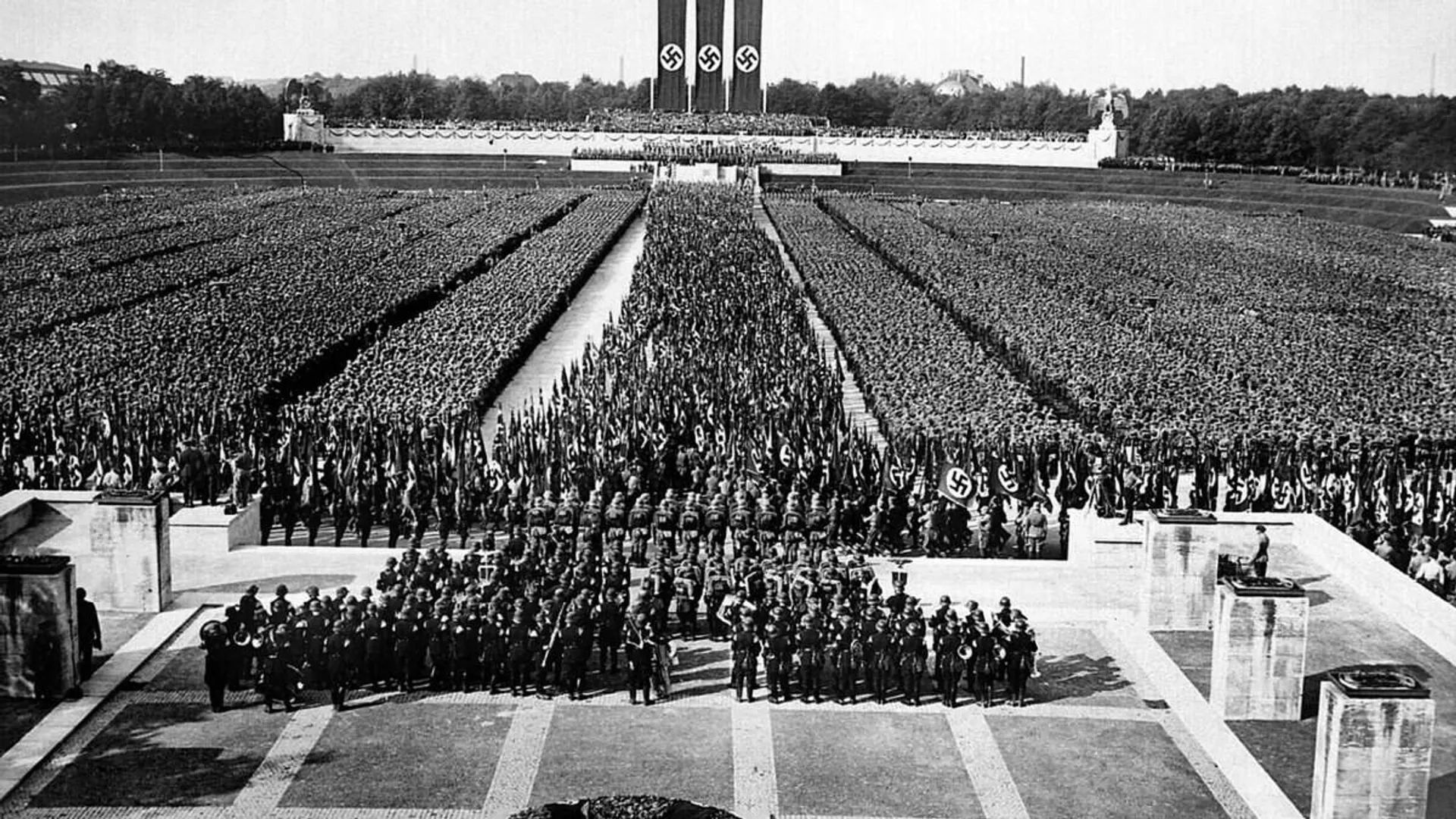
Hitler himself conceived the rally as a stage-managed performance for Riefenstahl’s cameras. He personally approved her involvement and allocated enormous resources to the production: 170 technicians, 30 cameras, cranes, tracks, elevators, and custom-built towers. The result was a monumental orchestrated event, equal parts political rally, mass theatre, and cinematic performance—an early and chilling example of politics designed primarily for the camera.
Content and Structure
Triumph of the Will opens with a vision of divine descent. A plane glides through the clouds above Germany, and a voice-over proclaims that Hitler has come “from the heavens to bring light to the German people.” From the outset, Riefenstahl constructs a mythic narrative rather than a documentary record.
The film follows the sequence of the 1934 Nuremberg Rally over four days, intercut with speeches, parades, mass formations, and ceremonial rituals. But, crucially, it contains no reference to party politics, anti-Semitic rhetoric, or the military. Instead, it presents an aestheticized pageant of national unity, defined by discipline, strength, and ecstatic devotion. There is no story or character development. Instead, the rally is the subject. The film constructs meaning through repetition, rhythm, and spectacle—transforming politics into ritual and the leader into myth.
Propaganda through Form
The film’s cinematography is astonishing for its scale and precision. Riefenstahl used cranes, tracking shots, telephoto lenses, and aerial photography—techniques typically reserved for narrative cinema. These innovations serve a clear purpose: to magnify Hitler’s presence and reduce the individual spectator to insignificance.
-
Low-angle shots of Hitler make him appear monumental.
-
Overhead shots of the masses turn people into patterns, erasing individuality.
-
Smooth tracking shots along rows of soldiers give a hypnotic rhythm, transforming human beings into mechanical extensions of the totalitarian state.
In one famous shot, Hitler drives through ranks of adoring troops. The camera moves with him, gliding at waist height so that his hand waves appear to pass over an endless field of faces—an image of divine acknowledgment.
Interpretation: The Myth of the Führer
What makes Triumph of the Will so effective as propaganda is its transformation of politics into myth. Hitler is never portrayed as a politician or general but as a quasi‑religious figure.
The film is structured like a passion play with Hitler as both messiah and redeemer. Early scenes emphasize his isolation: he travels alone, surrounded by clouds, descending to earth. Once in Nuremberg, his presence animates everything—the arrival of light, order, and harmony. His image is always central, surrounded by adoring followers who look upward in veneration. Even when he speaks, Riefenstahl frames him from below so that he seems to tower over humanity.
The key message is simple and repeated endlessly: Hitler is the embodiment of the German people, and unity can only be achieved through him.
When he declares, “The Party is Hitler, and Hitler is Germany as Germany is Hitler,” the crowd’s roar answers as though in liturgical response. The film doesn’t argue this—it enacts it. By the end, the viewer has witnessed not a series of speeches but a slow, methodical deification of power.
Reception
Triumph of the Will premiered in March 1935 at the Ufa Palace in Berlin and was hailed by the regime as a masterpiece. Internationally, it received awards, including a gold medal at the Venice Film Festival and the Grand Prix in Paris in 1937. Critics admired its formal perfection long before recognizing its political toxicity.
After World War II, Allied authorities banned the film in occupied Germany, deeming it dangerous propaganda rather than historical documentation. Yet filmmakers and historians continued to study it for its technical brilliance. Riefenstahl herself denied any political responsibility, insisting she was merely an artist documenting “history”.
In the postwar period, the film influenced not only overt propaganda but also the aesthetics of mass spectacle and advertising. Its techniques of lighting, symmetry, and crowd choreography informed countless political and commercial productions. As Susan Sontag famously observed in her essay Fascinating Fascism (1975), Riefenstahl’s later work in photography and underwater documentaries preserved the same obsession with “physical perfection, submission, and power”.
Legacy and Lessons
Today, Triumph of the Will is both a vital historical record and a continuing threat. It must be studied—but never admired uncritically. Modern screenings are typically accompanied by contextual introductions to prevent misinterpretation. Riefenstahl’s technical achievements cannot be detached from their purpose: to sanctify dictatorship.
The film underscores an uncomfortable truth about cinema’s power. Moving images do not merely reflect reality—they can construct it, transforming ideology into emotion, and emotion into belief. In Triumph of the Will, Riefenstahl discovered the cinematic language of totalitarianism: rhythm, spectacle, and the obliteration of the self.
Nearly a century later, her film still warns us how easily aesthetics can serve tyranny—how beauty, in the wrong hands, becomes the most persuasive form of power.